Debunking SCS: playing in a foam playground rather than on a Dungeons & Dragons battlefield.
For two decades,
Sword Coast Stratagems (SCS)
has reigned supreme in Baldur’s Gate mod recommendations.
The promise is enticing: a revolutionary AI that transforms every mage into a tactical genius. But behind the 3GB of data and the glittering pre-buffs, what truly remains of the original experience?
Between dubious perks that facilitate exploits (the infamous ‘1 HP’), iconic spells like the Chromatic Orb that have been distorted, and a rigid scripting that makes opponents more predictable than ever, it’s time to debunk the myth.
On the eve of Forgotten Edge‘s release, let’s analyze why SCS, despite all the heart its developers put into it, ultimately becomes an obstacle to true game intelligence.
Prologue: The Illusion of Intelligence on a Stone Anvil
Sword Coast Stratagems (SCS) promises a revolution: an AI capable of simulating human thought. Yet, the 1998 Infinity Engine offers only the equivalent of a stone and a sledgehammer for coding. For a developer, the lack of fundamental tools—no loops, no arrays, no lists, and not even basic arithmetic—makes creating a true strategy algorithm (like Min-Max) impossible.
SCS’s AI isn’t “intelligent” in the modern sense; it’s a vast library of rigid conditions stored in the trigger.ids and action.ids files.
The problem?
Many of these functions are buggy or simply inoperative depending on the context. To compensate, SCS piles up lines of code: some scripts reach 19,000 lines.
The result?
Even on modern machines, there are slowdowns and an inertia that ultimately makes the enemy predictable. You don’t create a chess grandmaster by simply listing all possible answers; you end up creating a cumbersome automaton incapable of improvisation.
Chapter 1: “SCS Plays Fair”: The First Lie?
The author claims that “SCS plays fair.” But the reality on the ground is more nuanced. While raw stats (HP, AC) aren’t systematically inflated to leave that to Legacy of Bhaal, the deception lies in the arbitrary modification of abilities.
The Case of Spells and “Gifts”
SCS takes the liberty of rewriting the rulebook of iconic mages. Why remove Krystin’s Cloudkill or radically change Silke’s behavior by giving her massive summons (going from 1 or 2 to 5 creatures)?
The Tactical Bias: Under the guise of balance, historical threats (the carnage of a Cloudkill) are removed from the player and replaced with scripted obstacles that, paradoxically, facilitate certain exploits.
Omniscience (Cheat):
The author’s admission is terrible: his scripts are so long that they end up granting enemies psychic powers. An enemy mage shouldn’t “know” you’re wearing a Charming Protection Helm until they’ve failed to charm you.
SCS skips the learning phase and goes straight to the countermeasure.
Communication of the Deaf
In an engine where communication between agents is limited to “Shout” and “Heard”, tactical coordination is a mirage. Where a true AI mod should manage positioning and mutual support, SCS often simply converges everyone via automatic targeting scripts.
An “intelligent” Basilisk should understand after two rounds that its petrifying gaze is failing and switch to its claws or poison.
Instead, SCS prefers to multiply invisible detection conditions, transforming combat into a scripted reading rather than an organic tactical duel.
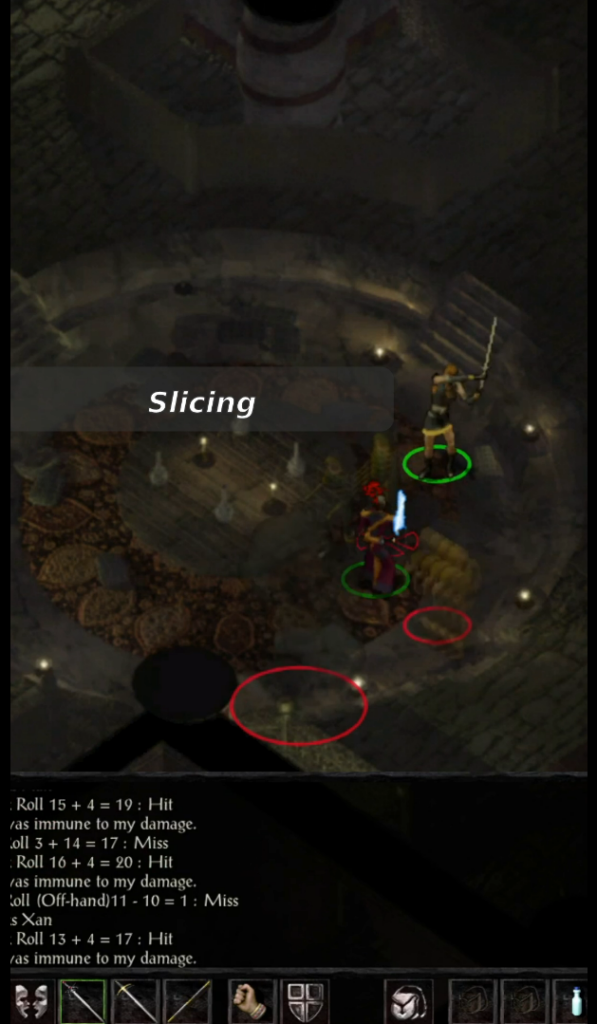
Chapter 2: Between Poisoned Gifts and Highways to Exploits
SCS promises to make the game more difficult. Yet, in practice, one realizes that the mod closes some tactical doors only to open others, much wider and less glorious.
The Chromatic Orb and the Childish Safety Syndrome
The Chromatic Orb spell is emblematic of Baldur’s Gate. Its -6 saving throw is a subtle threat that demands caution. By “nerfing” this spell under the guise of fairness, SCS removes a thorn in the player’s side. This is the first in a long series of “gifts” that transform a dangerous world into a predetermined path.
The Krystin Case: When Roleplay Collapses
The Krystin example is glaring. In the original version, her Cloudkill is a real pain: it forces the player to manage complex positioning, especially for a Good-aligned party concerned about collateral damage.
The SCS change: By replacing this spell with Chain Lightning (level 6), the mod seems to increase raw power, but it actually makes combat easier. The lightning is predictable and spares neutral NPCs. Krystin becomes “clean”, almost kind, and most importantly, she loses the ultimate weapon capable of wiping out a character with 1 HP.
The “1 HP”: The feat turned system
This is where the “Colossus with Feet of Clay” truly falters. The recruitment of NPCs with 1 HP is an open secret, but SCS seems to be doing everything it can to protect it:
Disappearance of natural counters: By modifying mages to abandon persistent area-of-effect spells or instant kills (like the original Chromatic Orb or Cloudkill), SCS effectively grants immunity to the character with 1 HP.
The mindless swarm: Through the Shout and Heard abilities, enemies cluster around this dying character. Where even an Icewind Dale of the time knew how to keep his support units (Vestals) at bay, SCS troops charge headlong into the fray, blinded by a simplistic targeting script.
Bugs and technical shortcomings
The addition of new spells or complex behaviors brings its share of malfunctions that break immersion.
Icelance: Seeing a spell consistently travel southeast, regardless of the target, isn’t a difficulty issue, it’s a technical failure.
Tazok’s Tent:
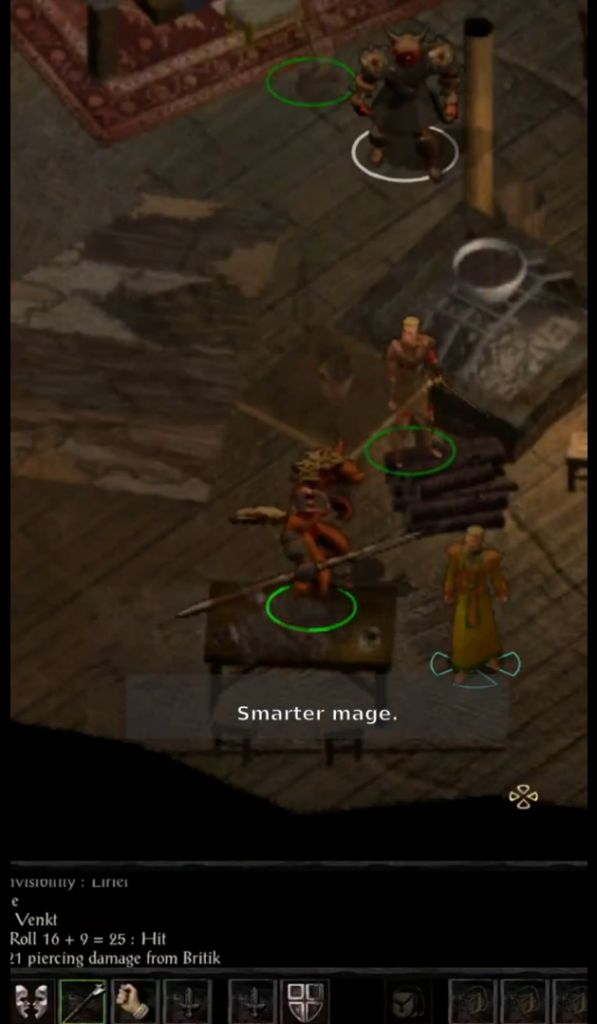
Charming Britik is enough to clear the area without the enemy scripts offering any coherent response. The mod adds soldiers (quantity), but forgets to give them the brains (quality) to react to the betrayal of one of their own.
Chapter 3: The Illusion of Magic and the Triumph of Brute Force
While SCS promises “intelligent” mages, the reality on the ground offers a very different spectacle: a riot of visual effects that masks a complete lack of tactical depth. In this shadow play, one character rises above the rest, not through sheer power, but because he exposes all the mod’s flaws: Xan.
Xan: From Genius Enchanter to Avatar of Ao
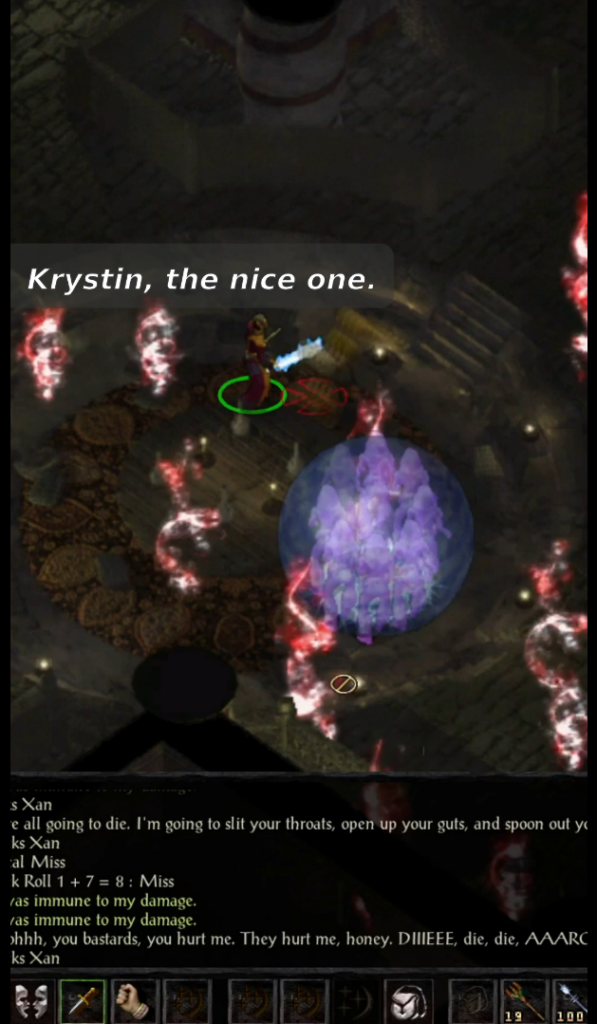
In the original game, Xan is a tactical gem: immune to charm, fire-resistant with the right equipment, and the absolute master of control (Sleep, Emotion, Chaos). But in SCS, he becomes Ao, the God of Gods.
Why?
The Spell-Raising Lightning Rod:
SCS’s AI relentlessly casts control spells like Sleep (which lasts an eternity in this mod). Xan, by virtue of his Elven nature and his “1 HP” status, absorbs these assaults without flinching. He’s no longer playing; he’s simply watching his opponents waste their mana.
Simplification by Fire:
Enemy creatures trapped around the Mage create a clear path for the use of the Wand of Fire. Thus, Mages, especially Xan, are advantaged by the Wand of Fire. SCS transforms the subtlety of Mages into a brute force that short-circuits battles meant to be complex (like Davaeorn).
The “Conglomerate”: The Failure of Positioning
The most critical point remains the behavior of enemy troops. Where a game like Icewind Dale managed the spacing of support units, SCS forces everyone to cluster together.
The Coffee Shop Tactic:
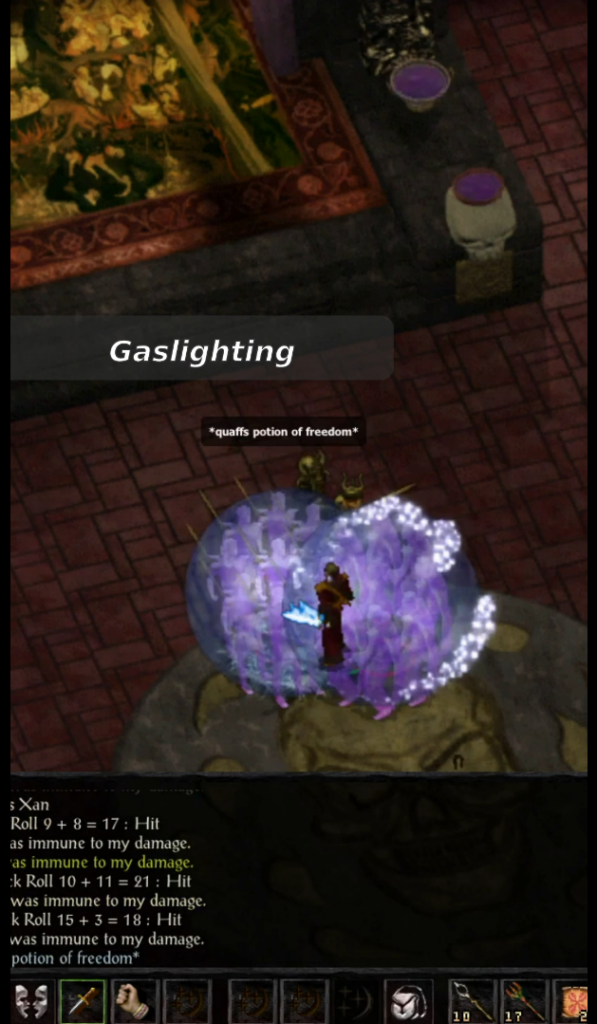
Since the enemies cluster around the “1 HP” character (your lightning rod), the rest of your team can literally go get a coffee.
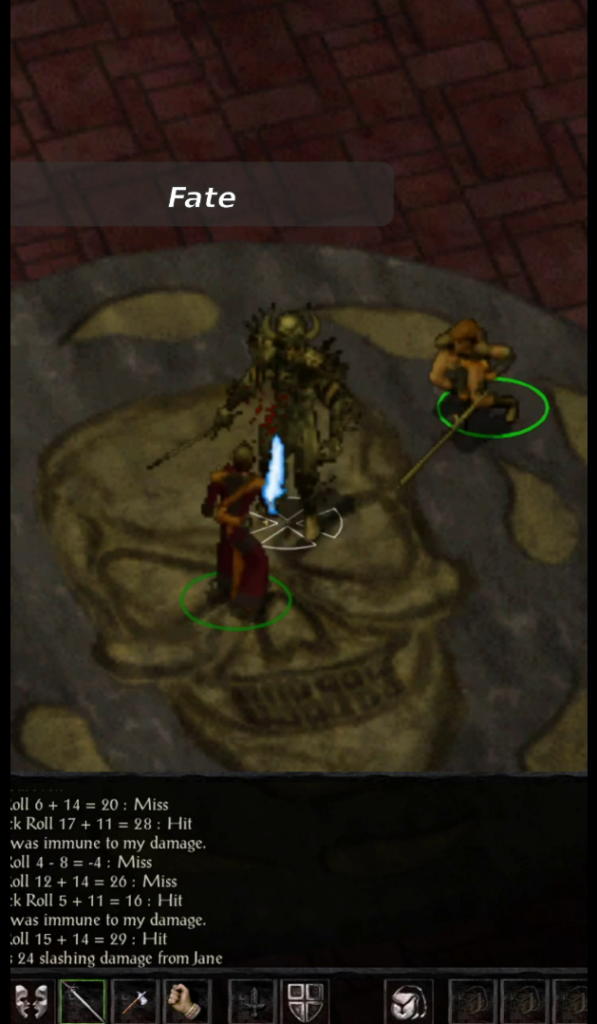
A Kensei with Spiderbane (for its range of 2 and immunity to movement) or an Archer with throwing axes methodically slices through mages protected by ten layers of useless spells. Mirror Images or Stone Skins are irrelevant: against an AI that can’t intelligently reassess its target (AttackReevaluate being its worst enemy here), brute force wins every time.
Conclusion: Polite Respect, but a Necessary Farewell
SCS is a colossal work. Its 3 GB of scripting command respect for the sheer effort involved. However, in trying to plan for everything, it ended up breaking everything. It transformed Baldur’s Gate into a game of predictable “puzzles” where the sheer scale of the achievement (the 1 HP) and the rigidity of the scripting (the lack of invisibility, the absurd targeting) kill the spirit of adventure.
The conclusion is undeniable: SCS isn’t “hard,” it’s tedious. It doesn’t require magic, just patience and an awareness of its flaws.
Forgotten Edge arrives with a different promise: a return to organic difficulty, where the enemy reacts to your actions instead of reciting a 19,000-line script. It’s time to restore the Sword Coast’s danger, its unpredictability, and its original flavor.